 Agent Zoo
Who is eating my Mac?
Every AI agent on your Mac, shown as an animal with its mood, live CPU, memory, energy, battery blame and cost. Claude, Codex, Cursor, Copilot, Ollama and twenty more. Nothing leaves your Mac.
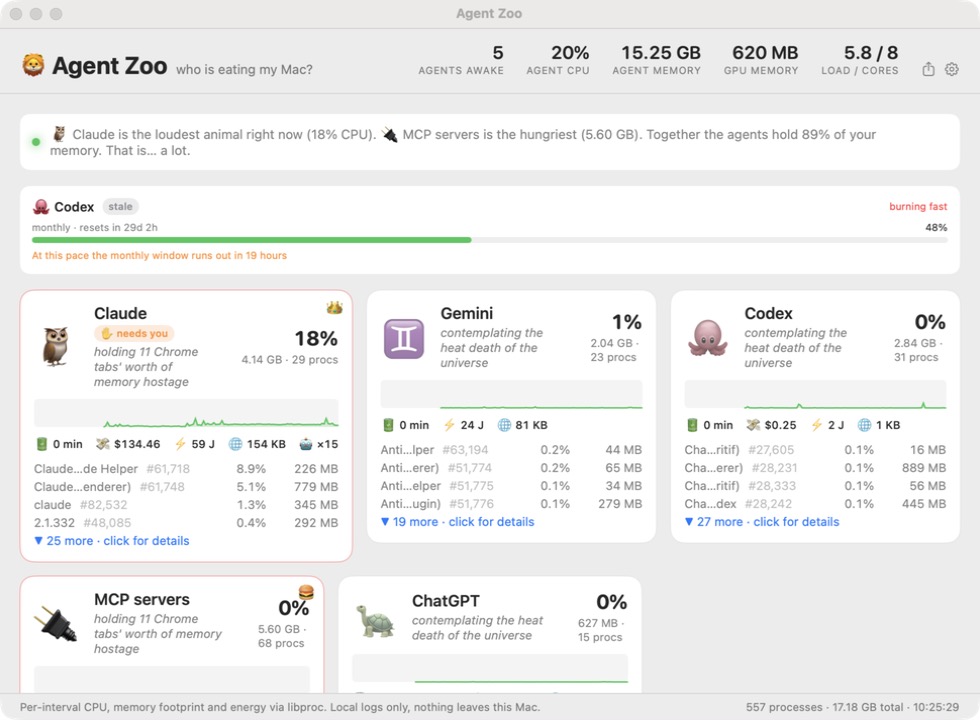
A monitor that knows what an agent is
Activity Monitor shows you 50 processes called node. Agent Zoo rolls every helper, shell and MCP server into the agent that spawned it, then tells you what that agent is doing.
Animals with moods
Idle animals nap, busy ones wiggle, hot ones catch fire. One glance tells you who is working. Serious mode for meetings.
Real numbers
Per-interval CPU and physical memory footprint, like Activity Monitor, grouped per agent and per process, with 7 days of history.
Knows the sessions
Which project each Claude Code or Codex session is in, whether it is working, waiting for you or stuck on a permission, how many subagents it spawned.
Cost and quota
API-equivalent cost per session and per day, Claude and Codex limits with reset countdowns, pace, and a “runs out at” estimate.
Alerts that matter
An agent needs you, finished, errored, went runaway, or crossed a CPU, memory, quota or dollar budget. Quiet hours and per-agent mute.
Zombie sweep
Finds the orphaned MCP servers and helpers left behind by closed sessions and cleans them up in one click.
Put an agent to sleep
Pause a whole agent tree with one click and wake it later. Kill with a confirmation. Jump to its project in your editor or terminal.
Local models too
See which Ollama or LM Studio models are resident, how much GPU memory they hold, and unload the idle ones.
Fun extras
Notch mode when an agent needs you, a desktop pet that walks while its agent works, awards, a shareable daily zoo report.
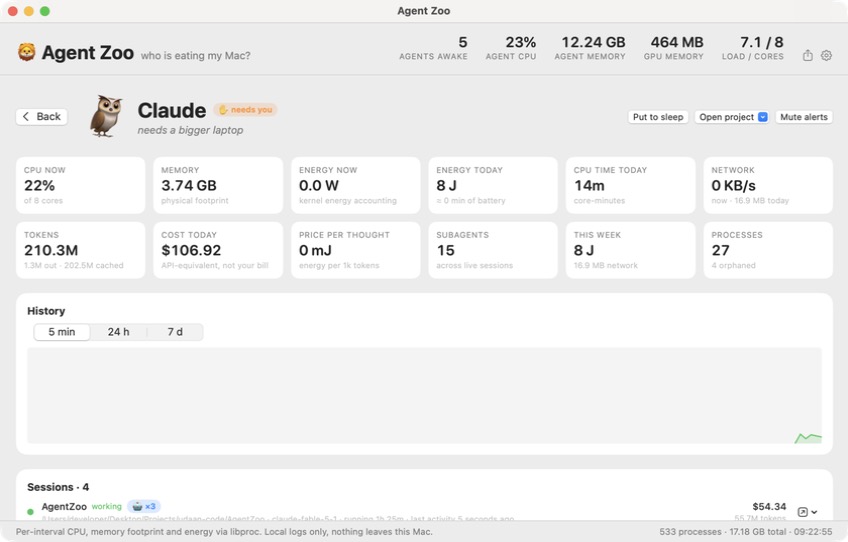
Click an animal for everything
Twelve stats, history, every session with its cost, and the full process tree down to the command line. Right-click to pause, resume or kill.
The zoo
Recognised out of the box. Add your own with a one-line rule.
Pricing
One app, one download. Pro is a key you paste in. Every Pro feature is free for 14 days, and the zoo stays free forever.
Free
- The zoo: animals, moods, quips
- Live CPU and memory per agent and process
- Agent detail page and process tree
- Pause, resume, kill
- Serious mode, custom rules
Pro
- Sessions, tokens and cost
- Claude and Codex quota with pace
- 24-hour and 7-day history
- Alerts, rules, quiet hours
- Machine and dollar budgets
- Zombie sweep, awards, daily report
- Notch mode, desktop pet, sounds
- A year of updates, 14-day refund
Team
- Everything in Pro
- Five keys, one invoice
- Slack webhook for “needs you” alerts (coming)
- Priority email support
Questions
Does it send anything anywhere?
No. It reads your processes with the same system calls Activity Monitor uses, and your Claude Code and Codex logs on disk. The only network requests are to Ollama and LM Studio on localhost. Licence keys are verified offline.
Is the cost what I am billed?
It is the API-equivalent price of the tokens your sessions used. On a subscription you are not billed that, but it tells you what the work was worth and which project is expensive.
How does it know an agent needs me?
From the transcript by default, and exactly if you turn on the Claude Code hooks in Preferences, which install a small local script into your Claude Code settings with one click and remove it just as easily.
Why not the App Store?
The App Store sandbox forbids reading other apps' logs and pausing their processes. A reduced App Store edition is planned for discovery; the full app is sold here.
Will it slow my Mac down?
It is a 3 MB native Swift app that uses about 4 percent of one core with every feature on, and the animations are done by the window server, not the app.
Refunds?
14 days, no questions. Email support@happifyapps.com.
Get the launch email
One email when 1.0 ships, with the launch price. No newsletter.